
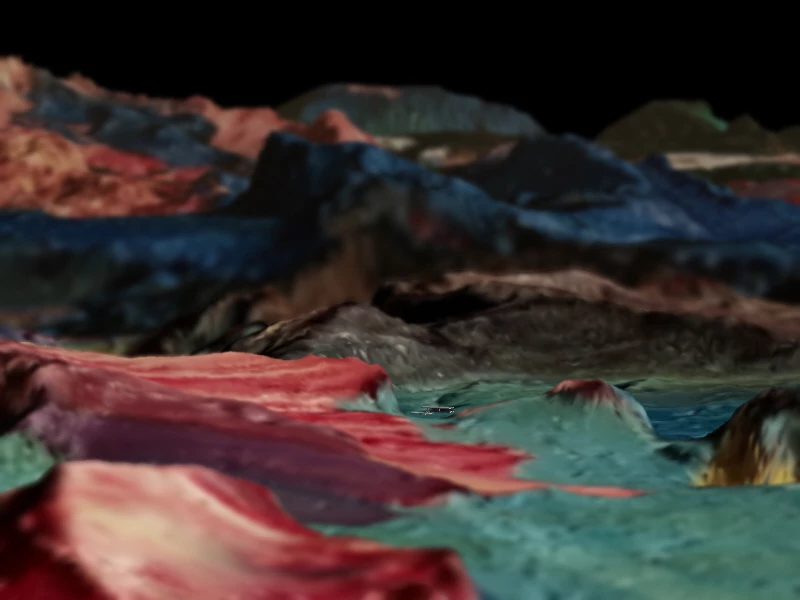
There are certain aspects that art preservation programs seem to entirely miss when making the switch to digital. Google Arts and Culture, is one such institution offering 'gigapixel' representations of famous artworks, to details the human eye could often not acknowledge in the original. The question remains what aspects are those scans missing?
Sketchfab has emerged as the platform of choice for many museums as it offered a relatively lightweight, accessible and robust 3D model viewer (E.g. The British Museum). The viewer provides tools for curation through 3D annotations and scenes enabling an experience akin to a guided tour, and be easily embedded into the museums own website for seamless experience of a collection.
The platform is especially desirable due to its integration with major Photogrammetric software, of which many artefacts have been documented due to the accuracy of material and patina. For what would often be thought of as flat works, paintings regain the quality of relief and in doing so, how they respond to light. Works done in thick oil shimmer as one looks from different angles, in thicker oils still, they can begin to self shade.
One such work visited White Rabbit Gallery, a contemporary Chinese art gallery of the Sydney suburb Chippendale. Titled "Spring festival is coming", a vibrant and energetic work by abstract expressionist Zhu Jinshi. Taking full advantage of the depth capable from layering paint by the pallet full. A work, as documented within the exhibition book, only receives a single front on view as proof of it's attendance. Though this is by no means the most egregious; Many video works are included only garnering a single frame, dimensions lost forever with the book alone.
Utilising Structure From Motion (SFM), a technique of interpolating photographs into 3D models, enables one to extract depth and embed that with colour information. The images and videos throughout this post are produced from applying SFM to Jinshi's work. In doing so, one can investigate surface texture, as a shifting point cloud through video, or obliquely as landscape.
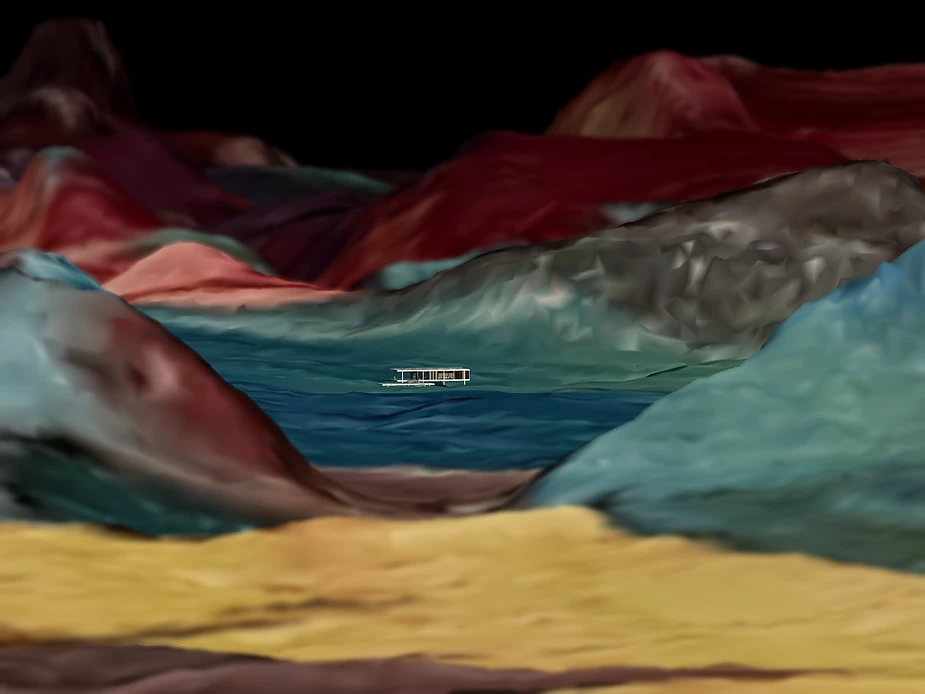
Despite these images housing Farnsworth House in, rather blobby rolling hills, it reveals the value one can extract from image content already on hand. Though these details cannot be published wholly in printed media leaving art books without full impressions. Digital representations can embody much more of work, and the context of it within an exhibition.
The below example is by the Hallwyl Museum of Sweeden, one of several models documenting the museum and its works in great detail. Through each model you can explore the museum and access additional information of the works.
Through SFM the museum can provide an impression of the curated view of a work. How it is places in reference to others of its time or place, and where it lies in the physical space museum.
As museums steadily digitise their works, it must not be seen as just a means of preservation. Capturing more than a single image enables those who may never access a collection first hand, who may miss a particular arrangement of works or a temporary installation. The issue lies much farther than lost patina, but at all scales, there are issues of translation. Just how many works may live on as only posters and post cards to never provide impressions or reference to their multi faceted, rough and specular surfaces? As these technologies become common place, viewers may now ask ‘what have I missed’?